
Tire myths are remarkably resilient, often resurfacing when discussing tires. While there are numerous myths about tires, like that they don’t expire or that all season tires are as good as winter tires for this challenging season, they are simply not true.
A tire myth may contain a grain of truth, as in the case of the notion that more tread equals better performance. Sure, tread depth is important for any tire, but you have to keep in mind that it isn’t the only factor that determines the performance of a tire.
For this reason, it’s crucial to have a bigger picture in mind when discussing tires and to always polish our knowledge about them. With this in mind, let’s discuss some prevalent tire myths and separate the truth from fiction.
Myth #1: Wider is Always Better
We can understand why people may believe in the myth that a wider tire is always better, since it will have a larger contact patch, or at least they change the shape of the contact patch to be wider. However, it’s important to put this into context and see if it’s still true.
Wider tires help maintain superb dry and wet-weather grip. Due to increased contact patch, which also provides better friction when stopping, wider tires also offer improved cornering and braking capabilities. Besides this, wider tires elevate your vehicle’s appearance, making it more aggressive and sporty looking.
Besides being more expensive, wider tires also come with increased rolling resistance, ensuring your vehicle consumes more fuel in the process. Due to their larger contact patch and making more friction, wider tires have a more difficult time accelerating while also making it harder to steer as well.
As for winter conditions, wider tires loose to narrower ones as they can cut through the snow and grip the road, enabling your vehicle to move forward.
So, taking it all into consideration, wider tires offer some benefits, but they also have their disadvantages. Carefully weigh out the pros and cons before you decide to purchase wider tires, because you may not need them at all.
Myth #2: Upsizing Improves Performance (It Usually Doesn’t)
Another myth you can encounter on the internet is that upsizing improves performance. Upsizing is the replacement of original tires with larger ones. As such, the aspect ratio and the overall diameter size of tires are increased.
Upsizing is done with the intention of enhancing the vehicle’s performance. The increased tire size improves handling by offering better road grip and improving stability. Upsizing also offers a unique and aggressive appearance, while also enabling better ground clearance. Bigger tires also provide better comfort, since their sidewalls are more effective at absorbing shocks and vibrations during the drive.
While these benefits are great, we also have to be aware of the accompanying negative effects that upsizing creates. First of all, there’s the issue of price, as bigger tires are more expensive. Their larger sizes also increase weight and alter gear ratios, resulting in reduced acceleration. The rolling resistance is also increased with upsizing, making your vehicle consume more fuel in the process. Last but not least, upsizing can also affect speedometer readings, making them inaccurate.
Taking both advantages and disadvantages into account, you should think twice before upsizing, since it may not bring the benefits you want.
Myth #3: One Size Fits All (It Absolutely Doesn’t)
Some people still erroneously believe that one tire size will work on any vehicle or that it can perform optimally in all conditions. This can’t be further from the truth.
One and the same tire size, 275/55R20, for example, won’t fit all vehicles because they are designed for different performance, and as such, they need tires that are suitable for them. Light trucks require particular tires that enable their heavy-duty performance, while passenger cars do not need such tires since they are designed to handle lighter loads.
The dimensions of tires also affect handling and driving comfort. On one hand, wider tires and models with higher sidewalls are better at absorbing road imperfections, ensuring a smoother drive and higher comfort levels. On the other hand, lower-profile tires secure better handling and steering responsiveness.
Furthermore, just because tires are the same size, it doesn’t mean they can perform well in all seasons. Some tires utilize specific compound blends and particular tread patterns, making them drivable in one season but not in another.
The Truth About Choosing YOUR Best Tire Size
In order to find the best tire size for your vehicle, consult your vehicle’s manual or a sticker on the driver-side door jamb. It offers the necessary information regarding the tire size and its recommended pressure levels.
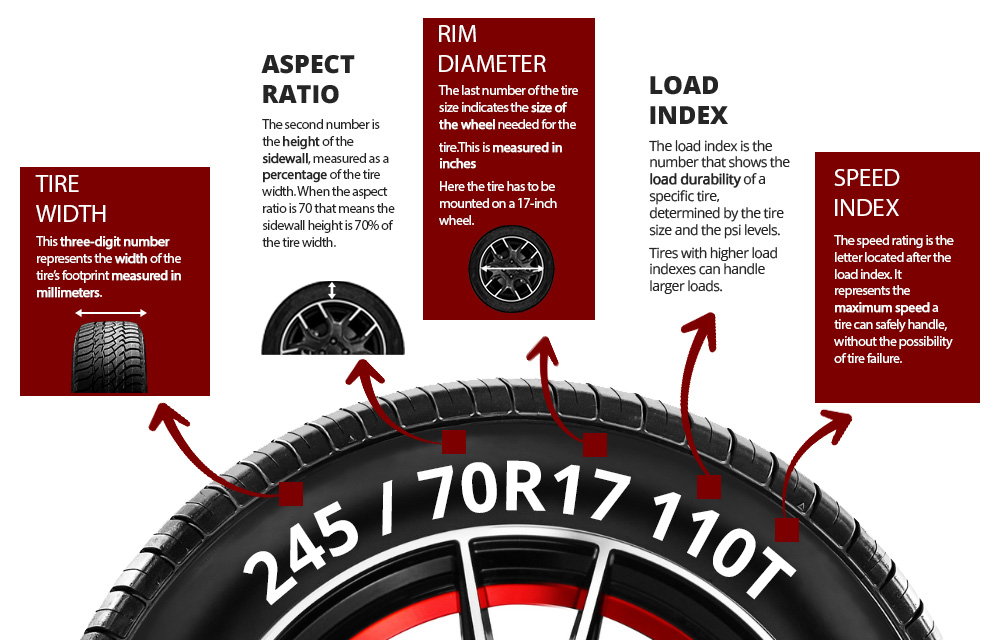
Returning to the tire size, it typically starts with a letter or two, be it “P”, “LT”, or “ST”, to mention a few, indicating that the tire is manufactured for specific vehicles like passenger cars, light trucks, or specialty trailers.
In our tire size example, 275/55R20, the first number (275) shows the tire width, measured from sidewall to sidewall across its footprint in millimeters. The following number (55) is the tire’s aspect ratio, which is the height of the tire’s sidewall shown as the percentage of the tire’s footprint width. The letter amid these numbers refers to the tire’s construction, which is usually “R”, standing for a radial construction, or “D”, meaning a diagonal construction. Finally, the last number (20) is the rim size, which tells us the size of the rim needed for the specific tire.
The tire size also includes accompanying digits with a letter or two, such as 113T. The number (113) represents the load index, informing you how much load a tire can handle, while the letter “T” is the tire’s maximum speed that it can safely maintain for a long time.
That said, it should be much easier to understand what kind of tires you need, particularly if you own a high-end vehicle. After all, you wouldn’t want the wrong tire size to affect your luxury car in a negative way and cause some damage, right?
Conclusion
The tire size is important to know and understand since it affects the performance of your tires, but also of your vehicle. Being such a prominent part of the tire purchasing experience, it’s bound to be the subject of myths, misconceptions, and exaggerations. However, once armed with knowledge, you can easily dispel false tales that circle around and ensure you get the tires you really need.
Read also: Continental ExtremeContact Sport Tire Review