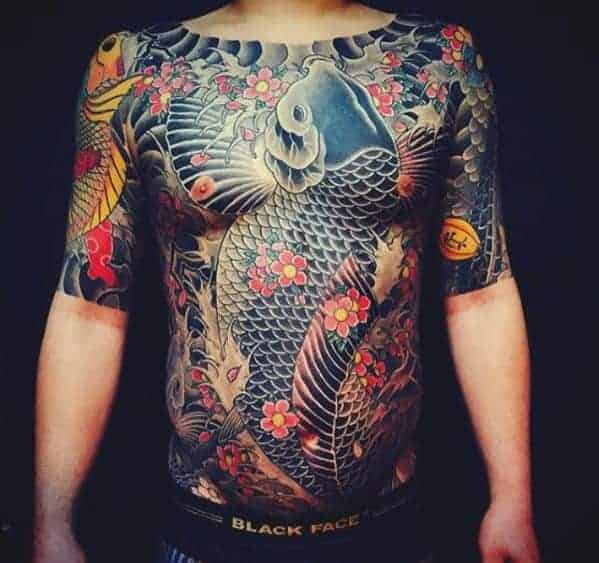

Koi fish tattoos represent a myriad of emotions and themes in life, including familial or romantic love, overcoming adverse circumstances, prosperity, and simple good luck.
Japanese traditional designs feature rich color, heavy single fill, and bold outline designs often covering large areas of skin. The elements – wind, fire, earth, water, wind – are also greatly important for filling out and supporting the major theme (shudai) of the koi fish.
The following article looks deeply into the various koi fish tattoo meanings created by Japanese ink. You can create an idea perfect for your own tattoo artist to bring to life on your skin.
Major Koi Fish Tattoo Symbolism
Koi fish have a positive, decorated history in Chinese and Japanese culture. Koi carp were domesticated and bred to produce particular versions of the beautiful fish to place in the pools of temples and the wealthy.
1. Dragon Koi Fish Tattoo Design
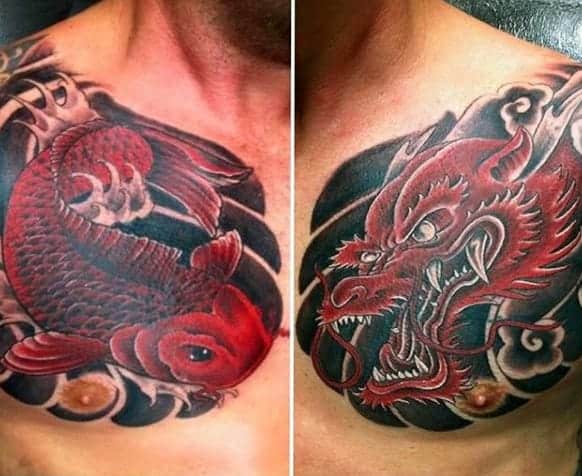
In Japanese legend koi fish are believed to be descended from dragons.
The story goes that once there was a huge school of fish made up of thousands of Koi swimming in the Yellow River in China. They went upriver, pushing against the current until they came to a waterfall. Many turned back, believing it was too difficult an obstacle.
Some koi, however, kept trying to jump over it. They kept at it for hundreds of years until finally, one koi made it to the top. To reward the bravery and persistence of this humble koi fish, the gods of the river turned that golden koi into a golden dragon.
Today the waterfall is known as the Dragon’s Gate, and some believe that any fish that can jump it will still be transformed into a dragon.
2. Koi Fish Yin Yang Tattoo Meanings
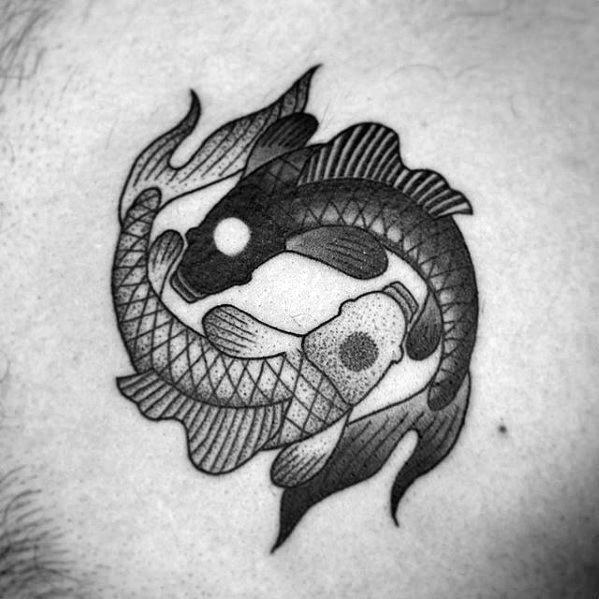
The popular yin yang tattoo is a design idea that often incorporates koi fish in the message – due to its links with perseverance and good fortune.
A yin yang tattoo represents more than just merely two opposite colors, it is a symbolism of life’s contrasting nature. This yin yang symbol has become a fundamental concept in Chinese philosophy and culture. You’ll find it at the origin of things like Chinese science, medicine, and even martial arts, exercise, and business.
For instance, consider things like hot or cold, dark and bright, and so forth. Not to mention, there’s the yang for masculine energy and the yin for feminine energy too.
The koi fish yin yang symbol serves as a reminder of the correct balance in life in order to reach true harmony. It also symbolizes the relationship between the two poles to show how the universe and life are always in a state of flux.
3. What Direction Are the Koi Fish Swimming In?
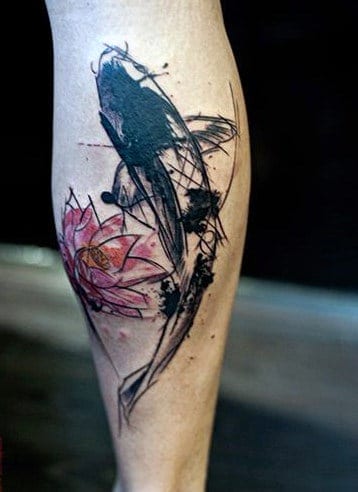
An important concept in koi fish tattoo meaning depicts which direction the fish swims in.
In Japanese tattoos, swimming upstream (upwards on the body) can represent struggle and perseverance.
A koi fish tattoo idea where it’s swimming downstream (down the limb or body) often represents that you have already achieved success. With the hard work done, the beautiful fish are now swimming with the current for a happy and prosperous life.
4. Koi Fish Tattoo Design and the Yakuza
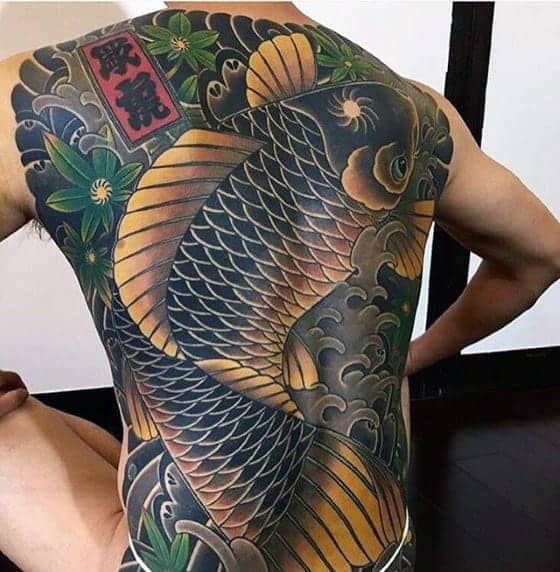
The Yakuza, Japan’s famously tattooed gangsters, most often sport traditional full body tattoos, and have their own terms to describe the different shapes and placement of koi tattoo design.
Their incredible lifespan – koi can live up to 200 years – and their prevalence in Japanese mythology make the koi fish tattoo meanings powerful for gangsters.
Symbolic meanings, especially the association with wealth, health, and good luck, are some of the most popular tattoo choices for those living on the wrong side of the law.
Key Color Koi Fish Tattoo Meanings
When I moved to Japan to teach English many years ago, Children’s Day was the first of the many bright and colorful festivals I got to see and experience.
Every May 5, Japanese families fly flags of the fish to represent each member of their household. It’s a bright and exciting festival filled with laughter and enjoyment. Depending on the color and the orientation of the fish, different meanings can be assigned to these images.
In Japan, each koi is associated with a different member of the family, and these patterns can be extended to tattoo ideas and concepts.
5. Black Koi Fish (Magoe)
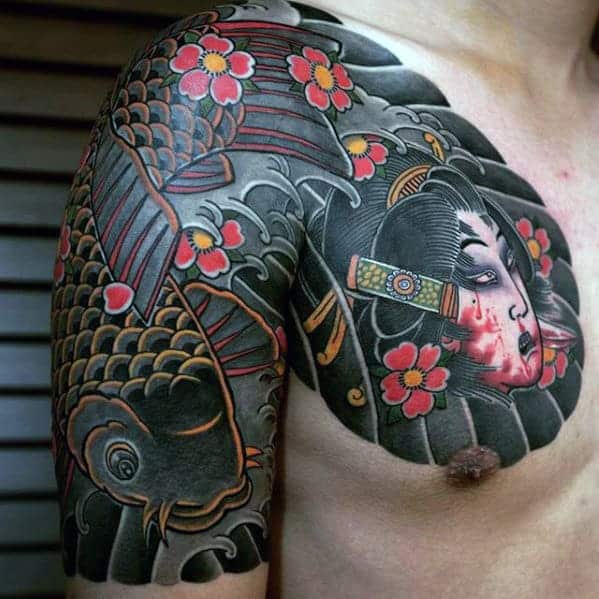
Black koi often represent struggling and overcoming an obstacle and is also the symbol of the father. Black koi fish are also common tattoos for people who have dealt with addiction or other traumatic events and managed to come out the other side.
6. Red Koi Fish (Higoe)
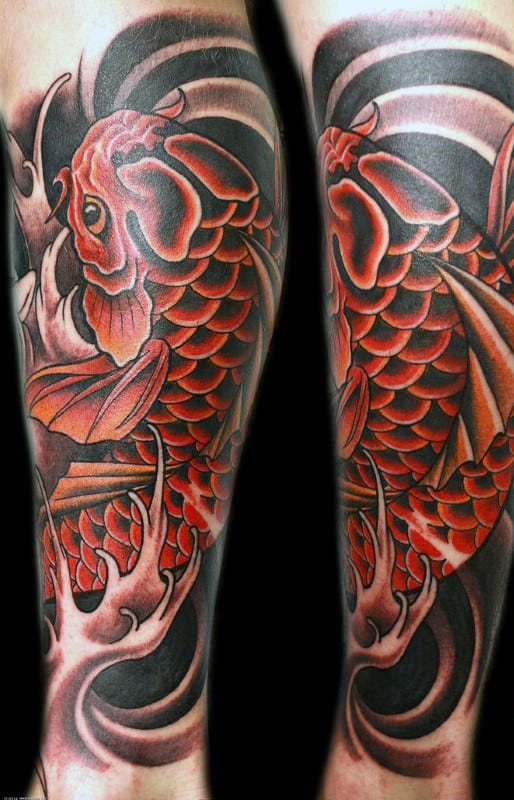
Red koi are often associated with an intense love as well as representing the mother of the family, while softer inked red, orange, and pink koi fish represent the daughter in each family.
7. Blue Koi Fish (Kigoe)
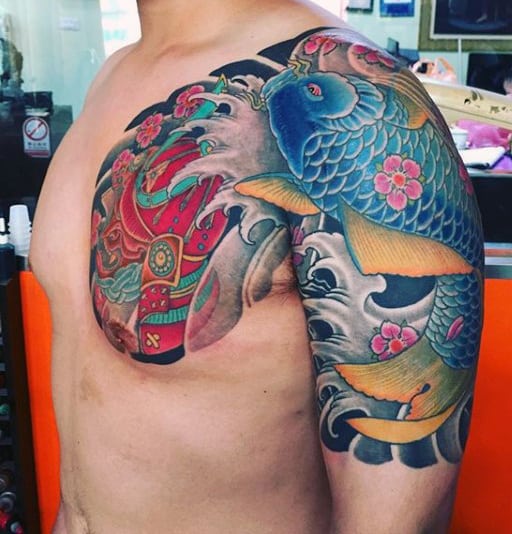
The masculine blue koi fish tattoos are symbolic of the son of a family, while also signifying the different meanings of tranquility and calm. They’re popular with younger men who are yet to start a family, who then add black koi tattoo designs later when they have children and become head of the family.
8. Yellow and Golden Koi Fish (Yamabuki)
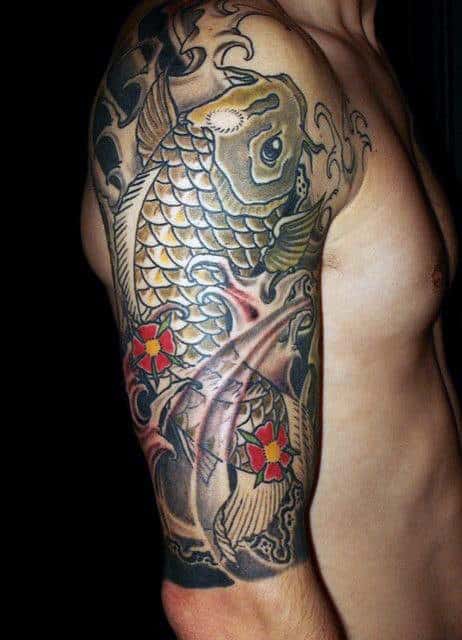
Yellow, orange, and golden koi fish tattoo designs are often used to symbolize wealth and good fortune and are known as yamabuki. This type of ink is often depicted in tattoos where the koi is the secondary message linked to other imagery.
Flowers and Koi Fish Meanings
Flowers (and filler imagery such as clouds, fire, waves, and wind) are often incorporated into koi fish tattoos to ascribe different meanings.
They can be a means of representing the season the collector wishes to portray in their body art, or a valuable secondary image (keshoubori) meant to further develop the main theme (shudai) of the piece.
9. The Koi Fish and Cherry Blossoms
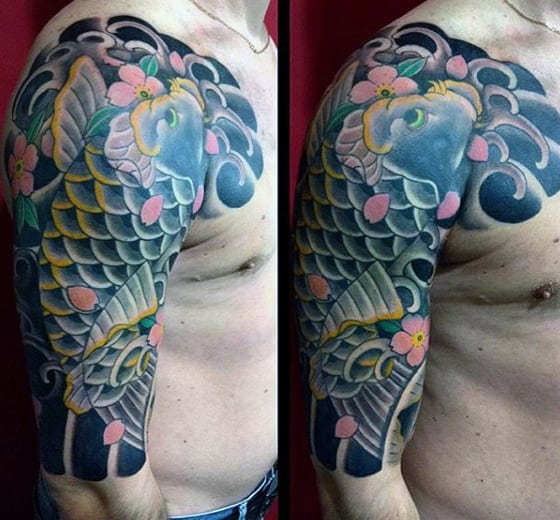
The cherry blossom (sakura) is one of Japan’s most enduring cultural icons and often part of traditional Japanese tattooing.
A cherry blossom is often etched in fine detailed pink and yellow tones, nuanced black and gray, or even vividly bright neo-traditional ink to symbolize fresh beginnings.
In traditional Irezumi, sakura was depicted as a keshoubori motif to signify the short life of samurai, or as a symbol of feminine beauty evening up a hyper-masculine design, such as a tiger, dragon, or the fierce Hannya Mask.
10. Koi fish and Lotus Flower Tattoo Meanings
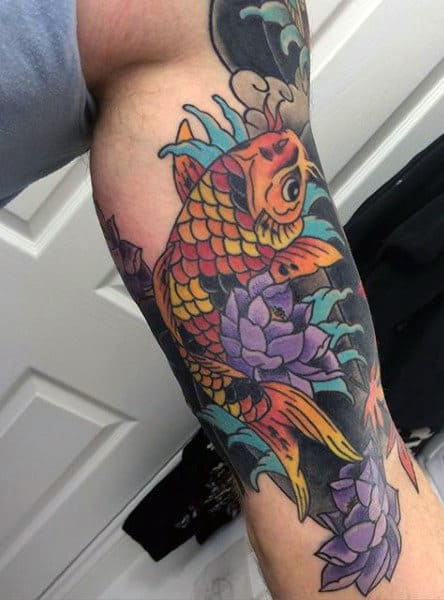
In Irezumi, the most common floral depiction is the lotus. Since the lotus is a flower that thrives in mud, it’s used to depict struggle and overcoming hardships. It is also frequently associated with transformation and rebirth.
11. Koi Fish and Peony Tattoos
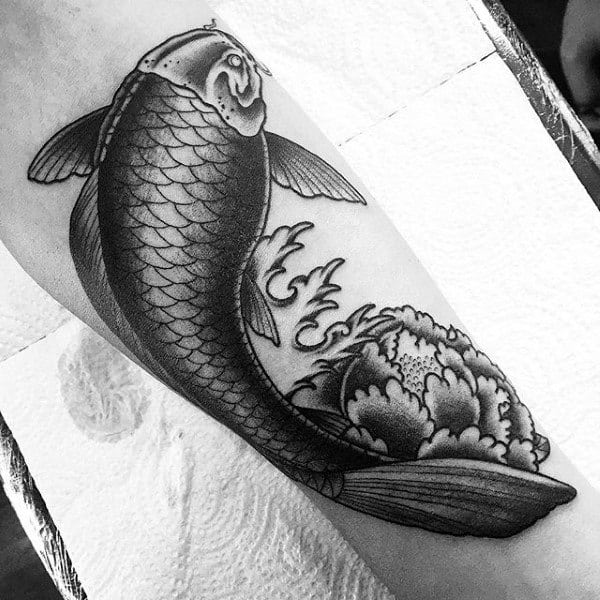
Because koi fish are often used to denote good luck and wealth, key positive connotations in tattoo culture for both Japan and China, they are often depicted with the peony.
Peonies are the floral tattoo version of the koi and are also linked to wealth and good fortune, doubling the message.
12. Koi Fish and Maple Leaf Tattoos
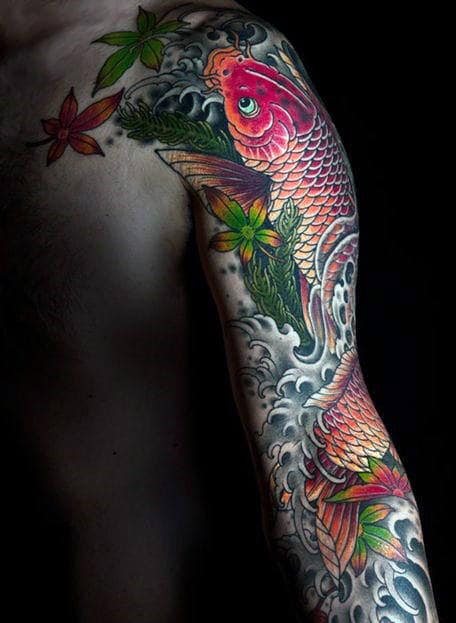
Linking the koi and maple leaf images has been popular in Japanese art and folklore since the early 19th century, an association that carries through to tattoo art and culture. Pairing a maple leaf (Momiji) with a koi is used to identify spring.
13. Koi Fish and Chrysanthemum Tattoos
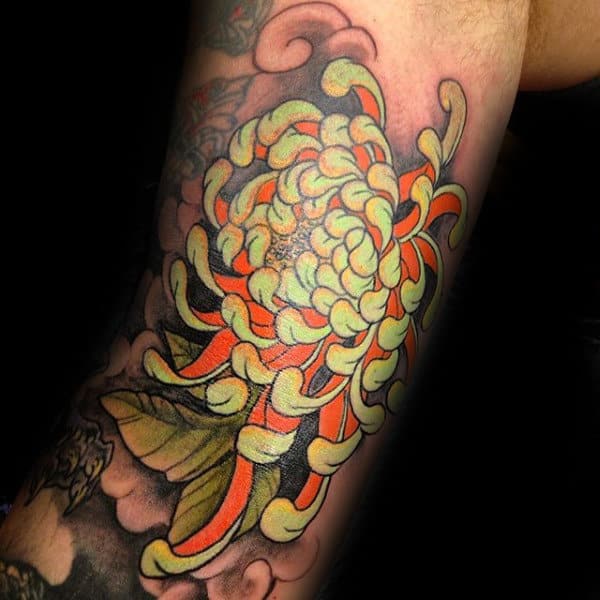
The chrysanthemum (Kiku) is the other classic floral design used in Japanese tattoos that dovetails with the ideas of prosperity and good fortune that a koi fish piece describes.
The chrysanthemum is linked to royalty and nobility (such as the Chrysanthemum throne) but more widely is associated with long life and good health