

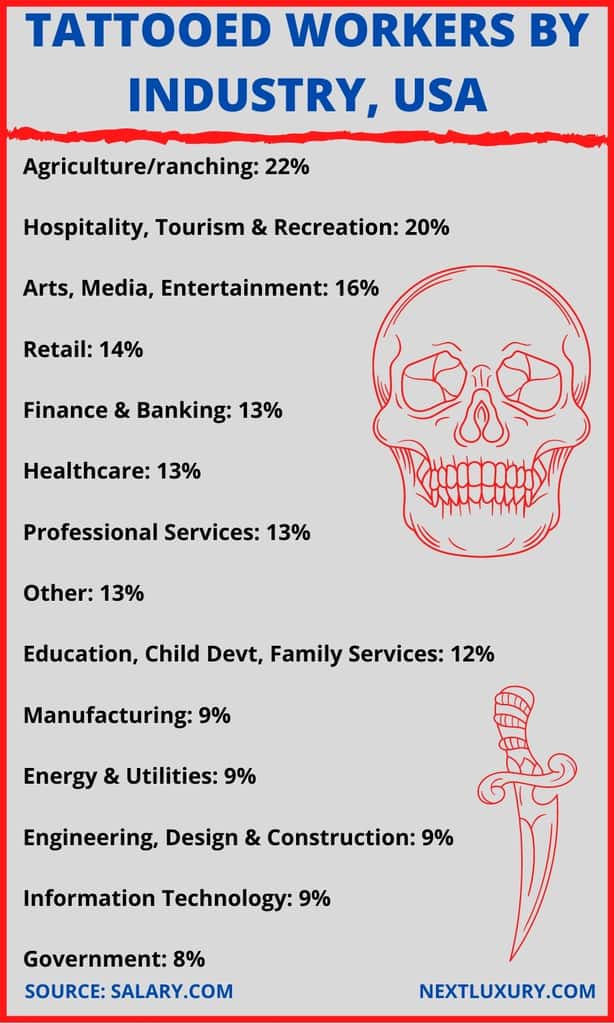
A salary.com survey found that workers in agriculture and ranching were the most heavily tattooed of US professions and that government employees were inked the least.
This is despite the growing popularity of tattoos generally and the huge jump in people getting visible tattoos such as face, neck, finger, and hand tattoo art in a variety of styles and symbolism.

Salary.com Survey
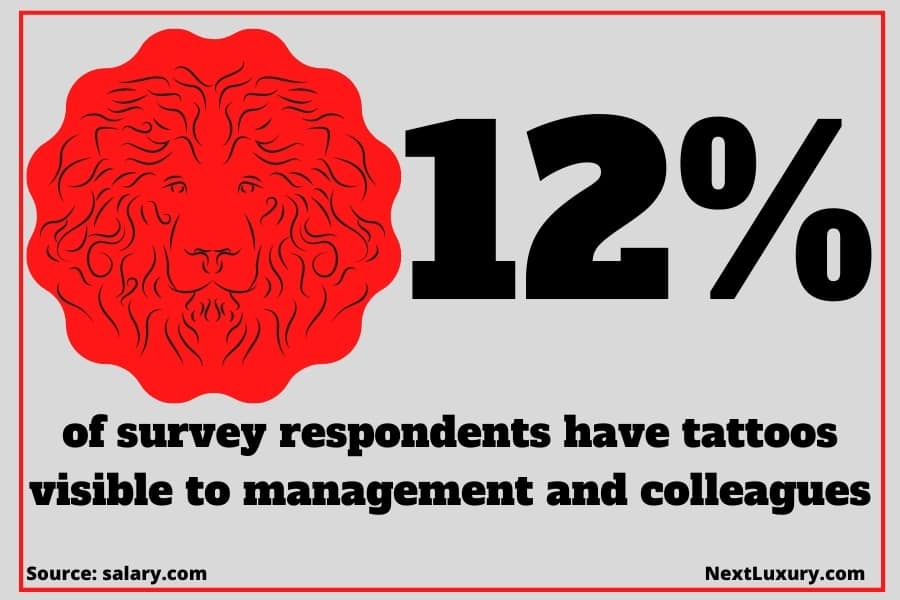
The US wide survey of 2,700 people found that 12% of respondents have a visible tattoo that can be seen by managers and co-workers during the workday.
Statistics, particularly with older generations, support the prevailing stereotype that “negative associations with tattoos may be partially reinforced by corporate appearance standards, either directly or indirectly, because individuals with visible tattoos are either not hired for jobs, not promoted to higher positions, or hide their tattoos in their corporate roles,” (Broussard and Harton, 2018).
Interestingly, 76% of all respondents said that having a visible tattoo or piercing can negatively affect your chances of getting a job at the interview stage.
39% of those surveyed said individual employees with tattoos and piercings reflect poorly on their employers, which stretches to 42% that feel visible tattoos are always inappropriate in the workplace.
Tattoos by Occupation

While universal attitudes toward tattoos are moving forward, there remain vast differences in how those with visible tattoos are treated. Knowing what to expect from customers, vendors, and other employees can be difficult to interpret, particularly in roles that emphasize public interaction (Flanagan and Lewis, 2019).
The most heavily tattooed workers by occupation in the salary.com survey, were those working in agriculture and ranching at 22%.
It must be noted, however, that other research suggests that as many as 36% of those serving in the US Military have at least one tattoo.
Workers in the hospitality, tourism, and recreation industry were second with 20% of workers tattooed, followed by 16% of people in the arts, media and entertainment industry.
Us Government workers are the least likely to be tattooed with only 8% of respondents stating that they sport tattoo art.
Here’s how tattooed workers by industry breaks down:
Changing Corporate Attitudes

The survey found that nearly 25% of respondents took a company’s acceptance of tattoos into account when contemplating accepting a job offer. This corroborates the viewpoint that people with tattoos, particularly those with visible tattoos, are helped in workplace situations where their ink isn’t held against them – they’d prefer to ‘act naturally’ rather than cover up just for the sake of a job.
A 2017 study by Rahman found that managers can effectively employ core values to the lessening of visible tattoo stigma while appealing to a different audience, and in doing so promote the value of their central brand viewpoints. (Rahman et al, 2017)
General society is moving towards tattoo normalisation, so the organisational argument against hiring, firing, or retaining persons with modifications is weakening, and frequently may not be in the company’s best policy, financial, and cultural best interests. (Elzweig and Peeples, 2011) (Jones and Hobbs, 2015).
References:
Broussard, K and Harton, H (2018) ‘Tattoo or taboo? Tattoo stigma and negative attitudes toward tattooed individuals’, The Journal of Social Psychology, 158:5, 521-540
Elzweig, B and Peeples, D (2011) ‘Tattoos and Piercings: Issues of Body Modification and the Workplace’ SAM Advanced Management Journal — Winter 2011, pp. 13-22
Jones, N and Hobbs, M (2015) ‘Tattoos and piercings – are they compatible with the workplace?’ NRC February 2015, vol 17, no 2 pp. 103-104
Flanagan, J and Lewis, V (2019) ‘Marked inside and out: an exploration of perceived stigma of the tattooed in the workplace’ Equality, Diversity and Inclusion: An International Journal Vol. 38 No. 1, 2019 pp. 87-106